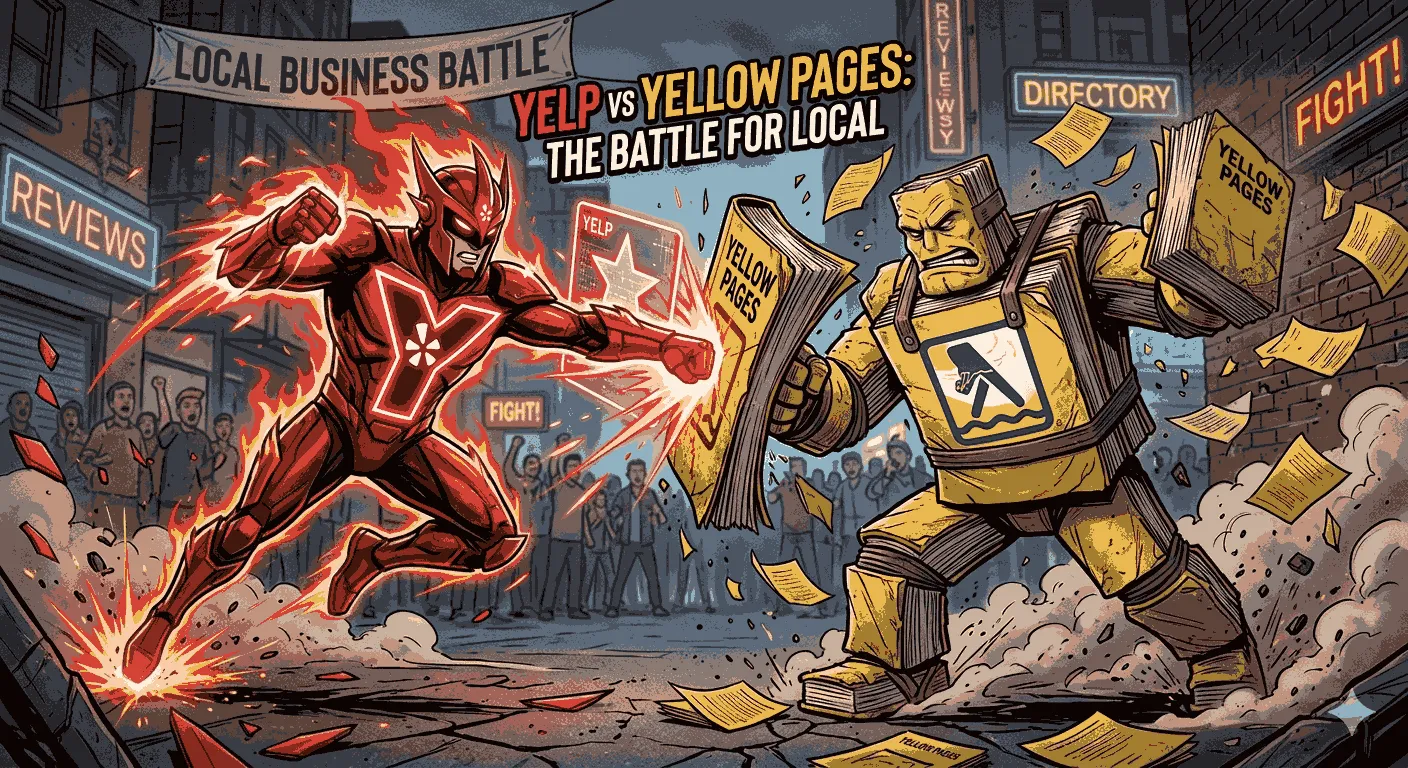
If you're searching for a definitive answer on which platform offers the best local SEO boost, you've come to the right place. Let's break down their key differences, advantages, and drawbacks to help you determine the winner for your specific business goals.
What We're Comparing
To give you a clear and actionable verdict, we will compare Yelp and Yellowpages across four critical dimensions:
1. Local SEO & Search Dominance: Which platform is more powerful at ranking in Google's local search results?
2. Traffic & Audience Intent: Where are your potential customers actively searching?
3. Reviews & Trust Signals: Which platform builds more consumer confidence and credibility?
4. Cost & Advertising: What is the financial investment required for each?
Yelp vs. Yellowpages: A Side-by-Side Comparison
Here’s a detailed breakdown of how these two directory giants stack up against each other.
1. Local SEO & Search Dominance
This is arguably the most important factor for any business owner.
Yelp: Yelp is an absolute SEO powerhouse. A comprehensive study found that Yelp appears in 29% of all local directory search results, making it the most dominant directory by a wide margin. It appears in the top 5 search results for 92% of local search queries. For many competitive local keywords, your Yelp profile can actually outrank your own business website, which is an incredible opportunity to capture high-intent traffic. However, a unique aspect of Yelp SEO is its internal search algorithm, which prioritizes positive, recent customer reviews above all else.
Yellowpages: Yellowpages is a solid, traditional player. It shows up in about 5.13% of local directory search results, which is certainly respectable. Its main strength lies in its high domain authority, which makes any listing a valuable "citation" for your business. A citation is simply an online mention of your Name, Address, and Phone number (NAP), and search engines like Google use these to verify your business's legitimacy and boost your local rankings.
SEO Verdict: Yelp wins. It has a significantly larger footprint in local search results and offers more direct ways to optimize your ranking.
2. Traffic & Audience Intent
Having a listing is useless if no one sees it. This section is about audience volume and their readiness to buy.
Yelp: Yelp has a massive, highly engaged audience, reporting 74 million monthly unique visitors. More importantly, these users have incredibly high commercial intent. A staggering 97% of people purchase from a business they found on Yelp within a week of their search. Yelp users are ready to make a decision, not just browse.
Yellowpages: Yellowpages also has a significant reach, with its brands used by nearly 80 million consumers each month. However, this traffic is less engaged and less "buyer-ready." The platform is often used more for research and verification—like finding a phone number or address—than for immediate purchasing. Yellowpages primarily serves as a reliable resource for discovering and contacting local businesses.
Traffic Verdict: Yelp wins. While both have millions of users, Yelp's audience is more motivated and has a proven history of converting into paying customers.
3. Reviews & Trust Signals
Today's consumers rely heavily on reviews to make informed decisions.
Yelp: Yelp is the undisputed king of user-generated reviews. As of 2025, the platform has over 330 million cumulative reviews, and it has built its entire brand around this system. They have also taken a strong stance on maintaining authenticity, actively filtering out suspected fake or AI-generated content. Their system also requires review text with every star rating.
Yellowpages: Yellowpages includes user reviews, but it is not the platform's primary focus. Its review volume is significantly lower, and the trust factor is more tied to its long history and brand recognition as an established directory rather than as a source of fresh, social proof.
Review Verdict: Yelp wins. For building modern, trust-based social proof, Yelp's extensive and moderated review system is vastly superior.
4. Cost & Advertising
Every business needs to consider the bottom line.
Yelp: Yelp offers a free basic business listing, which is sufficient for many SEO benefits. However, their paid advertising is a pay-per-click (PPC) model. Costs vary by industry, but small business packages typically start around $300 to $500 per month and can go much higher for competitive markets. The upside is the high-intent audience you're paying to reach.
Yellowpages: Yellowpages is much more budget-friendly. You can create a free listing quite easily. For paid advertising, it's significantly more affordable, with packages potentially starting as low as $19.95 to $24.95 per month for a "starts at" presence. The trade-off is a lower volume of targeted traffic and less commercial intent.
Cost Verdict: Yellowpages wins. For businesses on a tight budget, Yellowpages offers a more affordable barrier to entry for paid ads.
Which One is Right for Your Business?
Here's a simple guide to help you decide:
✅ Choose Yelp if:
· You are in a consumer-facing industry like restaurants, retail, hospitality, salons, or home services.
· Your goal is to drive new customer acquisition and sales directly through online discovery.
· You can actively manage your listing, respond to reviews, and have a strategy to generate consistent, positive feedback.
· You have a marketing budget that can support a higher-cost advertising model for a potentially higher ROI.
✅ Choose Yellowpages if:
· You are in a B2B, professional service, or niche local industry like accounting, legal, or medical fields.
· Your primary local SEO goal is to build citation consistency and legitimacy for Google.
· You are working with a limited marketing budget and need a cost-effective paid advertising solution.
· You want to maintain a foundational digital presence without the need for intensive ongoing management.
FAQ: Yelp vs Yellowpages
Does a YellowPages listing help with SEO?
Yes. Even a free listing is highly valuable as a local citation, which helps Google and other search engines verify your business's name, address, and phone number (NAP), boosting your local SEO foundation.
Is Yelp worth the money for a small business?
For many, yes. Yelp's high-intent traffic and strong conversion rates can make the paid advertising cost worthwhile. It's essential to start with a complete, well-managed free profile to gauge your organic success before investing heavily in ads.
Can I use both Yelp and Yellowpages?
Absolutely. They serve different purposes. Using both is a smart strategy: leverage Yelp for customer acquisition and social proof, and use Yellowpages as a foundational SEO citation for search engine trust.
Final Verdict
So, which platform takes the crown?
For most small and medium-sized local businesses looking to drive revenue, Yelp is the clear winner. Its unparalleled local search dominance, massive high-intent audience, and proven conversion power make it a superior engine for customer acquisition. While it requires more active management and a larger ad budget to fully leverage, the potential return on investment (ROI) is significantly higher.
However, Yellowpages is not without its merit. It serves as a fantastic, cost-effective tool for building your business's local SEO foundation. Its affordable paid advertising options and legacy of trust make it an excellent secondary platform.
The Smartest Approach
Use both. Claim your free listings on both platforms. Devote your primary time and marketing budget to winning on Yelp, where the customers are, while using Yellowpages as a vital piece of your local SEO citation strategy.